

Glossier
Project Context
As part of Arizona State University’s M.S. in Marketing program, I collaborated with a team to evaluate Glossier’s digital marketing performance and customer journey. Using SEMrush data, the project examined organic search visibility, competitor activity, acquisition channels, content performance, customer behavior, and opportunities for future growth.
My individual contribution focused on Glossier’s internal digital performance, including its dependence on branded search, customer acquisition weaknesses, content gaps, backlink quality, and strategic opportunities to improve non-branded discovery.
The Business Challenge
Glossier has strong brand awareness and a loyal customer base, but the analysis revealed that much of its digital performance was supported by customers who already knew the brand.
The central question behind my analysis was:
How can Glossier reduce its dependence on existing brand demand and attract more new customers through search, content, and digital discovery?
Metric Focus:
97.3%
Branded Search Traffic
2.7%
Non-Branded Search Traffic
476K
Estimated Organic Traffic
67%
Backlinks With Low Authority
SEMrush data analyzed during the project period. Metrics represent a point-in-time academic analysis and may change over time.
My Contribution
I was responsible for analyzing Glossier’s internal digital performance using SEMrush and translating the findings into strategic recommendations.
My work included:
Analyzing branded versus non-branded search traffic
Evaluating organic traffic and keyword trends
Comparing retention strength against acquisition performance
Reviewing keyword position distribution
Examining content performance by search intent
Identifying weaknesses in decision-support content
Analyzing backlink authority
Developing strategic recommendations for customer acquisition and SEO growth
Documenting the primary research sources used in the project
The Analytical Process
1. Acquisition Analysis
I first evaluated how Glossier generated organic search traffic.
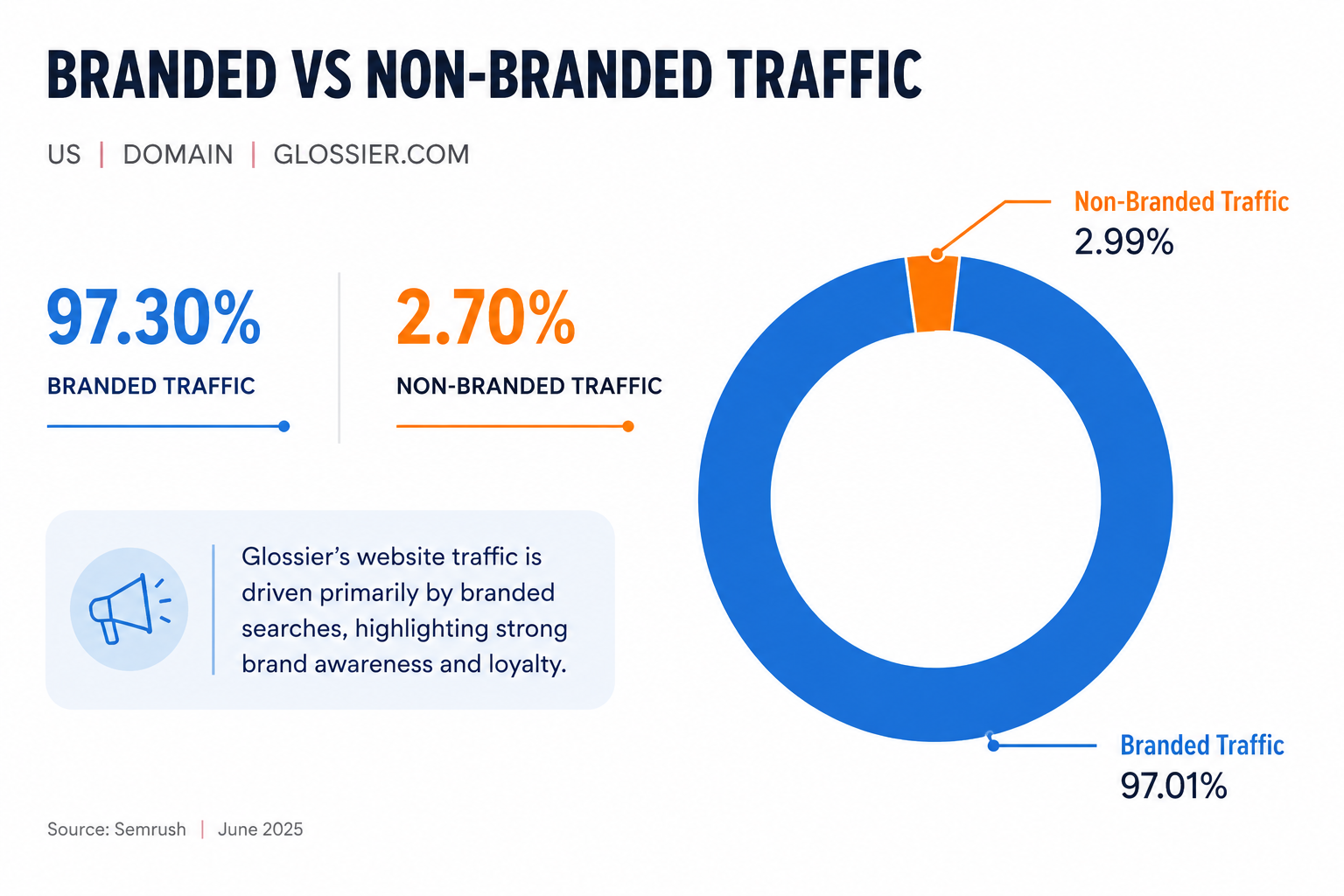
The SEMrush analysis showed that approximately 97.3% of Glossier’s search traffic was branded, while only 2.7% came from non-branded search. Organic traffic was approximately 476,000 visits, with a reported decline of 2%, while keyword volume had declined by approximately 12%.
Key Insight
Glossier’s strong traffic numbers did not necessarily represent strong new-customer acquisition.
Most visitors were already familiar with the company and actively searching for Glossier or one of its established products. The brand was performing well at capturing existing demand, but it had limited visibility among consumers searching more generally for beauty products or solutions.
Business Implication
This created an acquisition risk. A company that depends heavily on branded traffic may struggle to reach customers who have not yet entered the brand’s ecosystem.
2. Retention Versus Acquisition
I then compared the channels supporting customer retention with the channels responsible for attracting new customers.
Retention Strengths
Glossier demonstrated strength in:
Branded search
Direct website traffic
Email
SMS
Established product demand
Acquisition Weaknesses
The weaker acquisition channels included:
Non-branded SEO
Paid search
Generic product-category keywords
TikTok Shop conversion
Discovery-stage search visibility
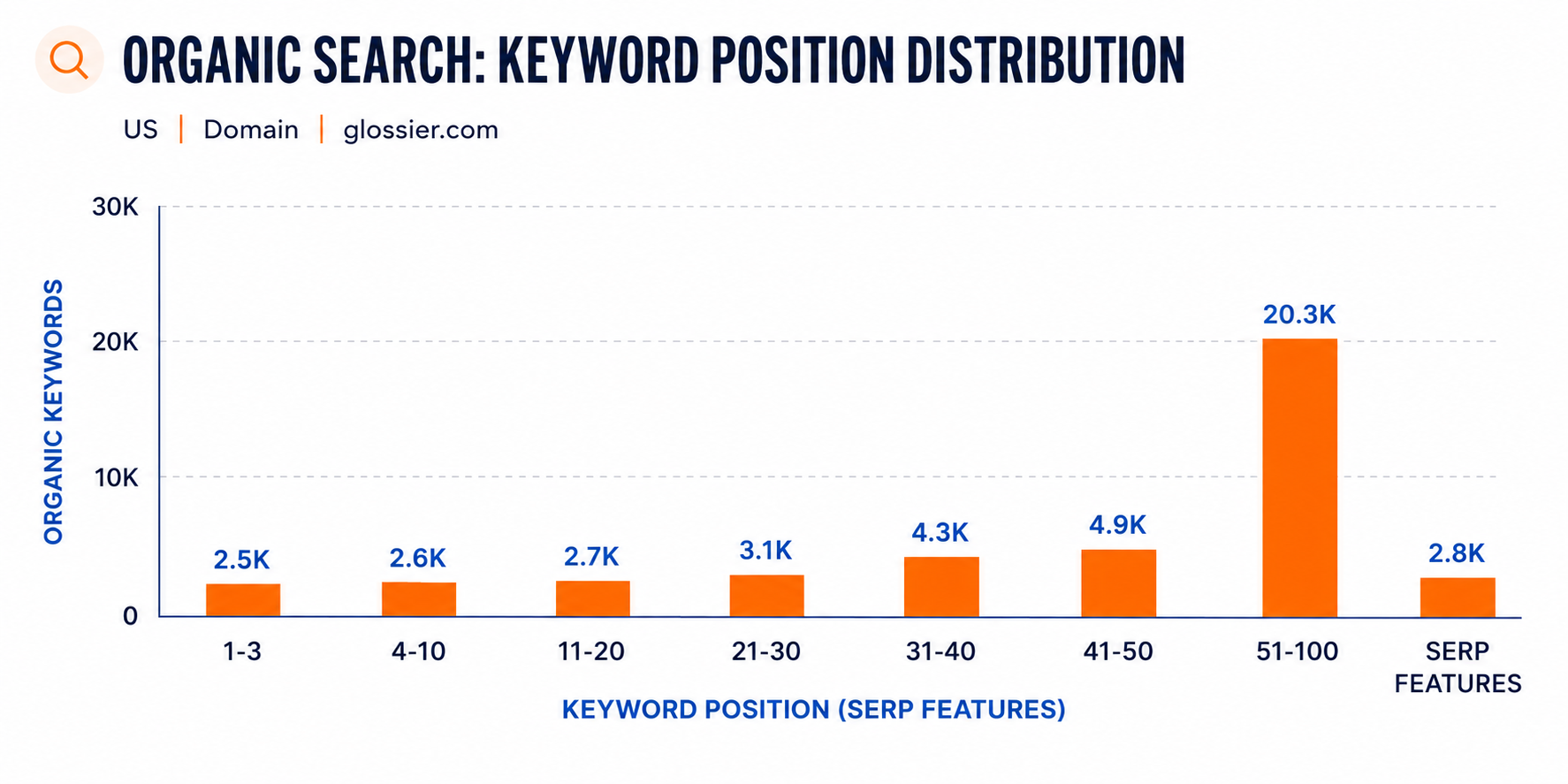
The keyword-position distribution also showed that a large number of Glossier’s keywords ranked between positions 51 and 100, limiting their ability to generate meaningful organic traffic.
Key Insight
Glossier had created an effective retention engine, but its acquisition engine was comparatively weak.
This meant the brand was successful at maintaining relationships with loyal customers while leaving significant opportunity at the top of the marketing funnel.
3. Content Gap Analysis
The next step was evaluating whether Glossier’s content supported customers throughout the decision-making process.
Content Strengths
Glossier’s content performed well in areas such as:
Brand storytelling
Visual identity
Social engagement
Lifestyle imagery
Awareness-building content
Content Weaknesses
The analysis also identified limited decision-support content, including:
Few product comparisons
Limited customer reviews and testimonials
Minimal ingredient education
Limited performance-based product information
Insufficient content addressing purchase objections
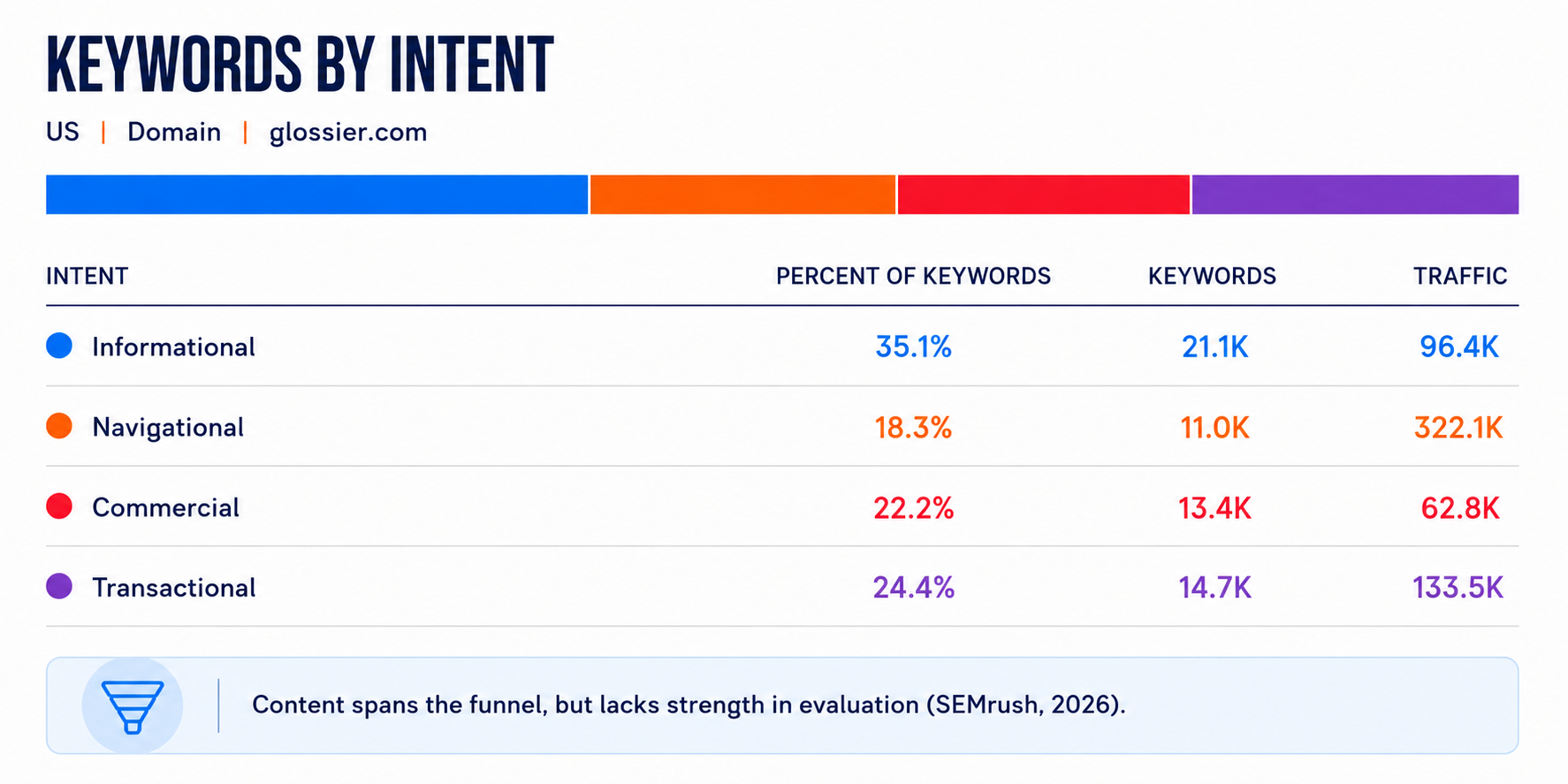
SEMrush intent data showed that Glossier ranked across informational, navigational, commercial, and transactional searches, but the brand lacked enough content to confidently support consumers during evaluation.
Key Insight
Glossier was highly effective at communicating what the brand looked and felt like, but less effective at explaining why an uncertain consumer should choose its products.
The website supported identity and inspiration more strongly than research and decision-making.
Business Implication
Customers seeking proof, comparisons, reviews, ingredient transparency, or product education may leave Glossier’s website to continue their research elsewhere.
Strategic Performance Evaluation
Priority One: Win Non-Branded Discovery
Glossier should expand beyond searches containing the company or product name and target consumers searching for specific beauty needs.
Recommended actions include:
Target high-intent, non-branded keywords
Develop content around common beauty questions
Create product-category landing pages
Publish problem-based skincare and makeup guides
Align short-form video content with search behavior
Strengthen TikTok and social-search visibility
Expected Impact
Increased new-user traffic
Greater organic visibility
Improved customer acquisition
Reduced dependence on branded demand
Priority Two: Strengthen Evaluation Content
Glossier should provide more evidence that helps uncertain customers evaluate products and make confident purchase decisions. Recommended content includes:
Product comparisons
Customer reviews
Before-and-after images
Video testimonials
Ingredient explanations
Product-performance claims
Frequently asked questions
Skin-type and routine guides
Expected Impact
Increased time on product pages
Reduced website exits
Greater purchase confidence
Higher new-customer conversion rates
Priority Three: Improve Acquisition Quality
Rather than focusing only on total traffic, Glossier should prioritize traffic from consumers with stronger purchase intent.
Recommended actions include:
Reallocate spending toward high-intent paid search
Improve TikTok Shop integration
Use product-led short-form content
Retarget consumers based on search behavior
Separate new-user and returning-user performance
Measure customer acquisition by channel and intent
Expected Impact
Better-quality website traffic
More efficient acquisition spending
Increased new-customer conversion
Stronger alignment between media investment and growth
Strategic Shift
The recommended strategic shift was:
Move from brand-led retention toward problem-based discovery and conversion-ready traffic.
Glossier should maintain the brand identity and community that support loyalty while investing more heavily in the channels, keywords, and content that introduce new consumers to the brand.
Tools and Skills Demonstrated
Tools
SEMrush
Google Slides
Digital research
Secondary-source analysis
Skills
Brand analytics
SEO analysis
Keyword research
Acquisition strategy
Content gap analysis
Backlink analysis
Customer journey evaluation
Competitive intelligence
Data visualization
Strategic recommendations
Team collaboration
Executive presentation
My roll
I conducted the internal SEMrush analysis presented in Slides 9, 10, 11, and 33. My work focused on Glossier’s branded and non-branded traffic, organic keyword performance, channel imbalance, content gaps, backlink authority, and strategic opportunities to strengthen customer acquisition. I also developed the final strategic performance evaluation and documented the project’s research sources.
Reflection
This project strengthened my ability to distinguish strong brand awareness from sustainable customer acquisition. At first glance, Glossier’s organic traffic appeared healthy, but a deeper analysis showed that most search traffic came from consumers who already knew the brand. By connecting branded-search dependency, keyword visibility, content intent, and backlink quality, I identified a broader acquisition challenge that was not immediately visible from total traffic alone.
The project also reinforced the importance of translating analytics into business recommendations. Rather than stopping at the metrics, I used the findings to recommend a shift toward non-branded discovery, stronger decision-support content, higher-quality backlinks, and conversion-ready traffic. Working as part of a group strengthened my ability to contribute specialized analysis to a broader integrated marketing strategy.